Legacy

Legacy. We hear that word from time to time, and it often has to do with a nostalgic reference to someone whose life profoundly impacted the life of someone else. On the grander scale, a legacy is considered to be ways in which one person or group of persons has profoundly impacted the lives of countless others. In this sense, legacies are often passed on from generation to generation.

In my family, one of our more tangible (and very heavy) legacies is an anvil. It has been passed down to the first born male Smith in my family since sometime in the 1880’s. My great-great grandfather, James Henry Smith, acquired the anvil for use in his business (yes, he was a true “smith”), and that anvil has stayed with us ever since. My grandson, Mason, will be the 7th generation to receive this legacy.

Most legacies aren’t quite as tangible (nor are they nearly as heavy) as this one. Most legacies are based on acts of bravery or bold strides made in social justice. Some legacies are character traits such as love and compassion. Some legacies are bad legacies as we sometimes see in peoples’ tendencies toward abuse or violence that are passed down within families. It i true: all legacies do, in fact, have the power to influence our lives for successive generations.

At Wellspring, we are talking about legacy. We are using our end of summer celebration service and covered dish luncheon (of course, Methodists don’t have real celebrations without eating) to celebrate the legacy that is Wellspring itself. We are honoring those who have given of themselves to make Wellspring what it is today, and we are using this as a way to continue clarifying our vision about who God is calling us to be in the future.

You see, legacy in its purest form is not about nostalgia. Legacy at Wellspring is about remembering who we are as we consider once again the values that were essential to the founding of our church. Values, such as hospitality and compassion and service and families in all the ways we have families structured these days, are critical to our mission. Values, such as true openness and acceptance of all people, no matter who they are, what they’ve done, who they love or what they look like, are values that continue to define and shape us as we move into our bold new future.

So legacy for us is our touchstone. Celebrating legacy is when we take time to look back to see what it was that shaped us at the beginning and what continues to shape us in our emerging reality. In my family, I discovered a paradigm that was brought to mind by the anvil. The anvil is a tool in the shop of a smith, and a smith is one who forges or gives shape to metals transforming them into things of beauty and function. As I realized the legacy that was mine, it occurred to me that my legacy is to be someone who helps forge … or give shape … or help bring meaning … to events and circumstances and people around me. And one way I do that is by helping us look carefully at our legacy together.

So what is your legacy? Is it a legacy that leads people to a better place? Is it a legacy that leads people closer to the Christ of their salvation? My prayer is that your legacy will be just that and will then last for generations to come!

Movements in Our Faith

I thought by now I would have arrived. I was wrong. The older I get, the more I realize I have to learn. The older I get the more I realize how much I still do not know. Wisdom is not knowing it all. Wisdom is the openness to hear God speaking.

I receive much praise for my preaching, and for that, I am grateful. When I receive these kind compliments, however, I have a response that comes from the heart: “When I preach, I am simply talking to myself and letting (or perhaps forcing) others to listen to that conversation.” That’s not false humility. It is gospel truth.

As I have aged and gained experience in ministry and as I celebrate my ministry among a people who are earnestly seeking to go where God is leading, I have discovered that God has much more to say to me than I previously would have thought. God is teaching me how to trust more. God is teaching me how to love better. God is teaching me how to live out my faith in ways I previously thought were simply not possible … or permissible. God is teaching me to “let go and let God.”

In short, I have discovered that my faith is a faith on the move. It is a dynamic faith. It is a faith that takes me to new places and greater heights than I ever thought possible. Some people use their faith to become more entrenched in their own biases and their own prejudices. I have discovered the absolute joy of a faith that pulls (no, that yanks) me from my trenches and propels me into places I never before considered.

Hospitality … no, it is Radical Hospitality (thanks to Bishop Schnase) … that has become a central theme of my ministry. It is what I discovered in the people at Wellspring, and it is one of the hallmarks of following Jesus. This is the kind of radical hospitality that breaks down the walls between us and that enables us to offer Christ to people no matter who they are or what they think or who they love. It is the kind of hospitality that makes true inclusiveness possible.

In the Gospel of John, we see Jesus move from a place where he believes he has come only for the “people of Israel” to a place where a gentile woman and a Samaritan woman can both feed on the crumbs that fall from the table and bathe in the wellspring that flows up to eternal life. If this kind of movement is possible for Jesus, then it is possible for us.

So I invite you to join us in this “movement” of faith. It is an opportunity to consider how we have often misused our faith to entrench ourselves and then reconsider how we might use our faith to move closer to the God who calls us to this place of radical hospitality where all are welcome and all are accepted!

A new movement is afoot! You are invited to join us as we move together into the arms of grace!

Standing at a Moment in History

No matter where anyone stands on the side of gay marriage, today was a moment in history. No doubt, there are people will be talking about this day in history for years to come. This was the day that the Supreme Court of the United States of America ruled in favor of the rights of gay and lesbian persons to be enjoined in marriage. Someone sent me the 105 page decision, and I only had a chance to scan through it. The one thing I knew, however, was that today would be a day long remembered in history.

Of course, the ruling of the highest court in the land does not mean that the church has reached consensus on this matter. The matter is far from settled among the people known as United Methodists, and it is still a matter to be discussed at the 2016 General Conference of the United Methodist Church to be held in Portland, Oregon. As we consider the impact of the ruling today, the one thing we cannot do is move to reactive positions on either side of the debate.

It was with that same pastoral sense that our own bishop, Mike Lowry, shared a pastoral letter with the clergy of our conference, and I think the best use of my space this week is simply to share the pastoral letter of our bishop here. What follows are the words of Bishop Mike Lowry as he addresses this matter with the clergy and with the people of our annual conference:

June 26, 2015

Dear Friends in Christ,

I write you in response to today’s ruling by the United States Supreme Court that same-sex couples have a right to marry anywhere in the United States. First, I offer spiritual guidance consistent with the best shared understanding of the Christian faith. Wherever you may be on a spectrum from overjoyed reaction to the ruling to deep despair over the Court’s decision, catch a breath. God is in charge of the universe, and we are not. This is a good thing. Christ still reigns and the Holy Spirit is still active in our lives. The advice of the Apostle Paul in Philippians 4 applies to us all regardless of our convictions on the contentious issue of same-sex marriage.

Let your gentleness show in your treatment of all people. The Lord is near. Don’t be anxious about anything; rather, bring up all of your requests to God in your prayers and petitions, along with giving thanks. Then the peace of God that exceeds all understanding will keep your hearts and minds safe in Christ Jesus.”  (Philippians 4:5-7)

While fully respecting the Supreme Court ruling, The United Methodist Church’s position on same-sex marriages has not changed. My understanding and that of our Conference Chancellor is that the Supreme Court’s decision is directed at state laws that bar same-gender persons from marriage and not at religious doctrine or church law, therefore the decision does not change section 341.6 of the Discipline or any other church law.”  [“Ceremonies that celebrate homosexual unions shall not be conducted by our ministers and shall not be conducted in our churches.”  (¶ 341.6 The Book of Discipline, 2012, p. 270)]

It is important to note that the decision contains the following statements concerning the rights of religious persons and organizations: “Many who deem same-sex marriage to be wrong reach that conclusion based on decent and honorable religious or philosophical premises, and neither they nor their beliefs are disparaged here.”

Paragraph 161f of The Book of Discipline, 2012 states: “We affirm that all persons are individuals of sacred worth, created in the image of God. All persons need the ministry of the Church in their struggles for human fulfillment, as well as the spiritual and emotional care of a fellowship that enables reconciling relationships with God, with others, and with self. The United Methodist Church does not condone the practice of homosexuality and considers this practice incompatible with Christian teaching. We affirm that God’s grace is available to all. We will seek to live together in Christian community, welcoming, forgiving, and loving one another, as Christ has loved and accepted us.  We implore families and churches not to reject or condemn lesbian and gay members and friends. We commit ourselves to be in ministry for and with all persons” (p. 111).

The Discipline goes on to state: We affirm the sanctity of the marriage covenant that is expressed in love, mutual support, personal commitment, and shared fidelity between a man and a woman. We believe that God’s blessing rests upon such marriage, whether or not there are children of the union. We reject social norms that assume different standards for women than for men in marriage. We support laws in civil society that define marriage as the union of one man and one woman” (¶ 161b The Book of Discipline, 2012, p. 109).

Nothing about our current doctrine or discipline has been changed. United Methodist clergy are not permitted to perform same-gender marriages and such ceremonies may not be held in our churches. Performance of a same-sex wedding ceremony is a violation of current church law (¶ 2702.1(b) The Book of Discipline, 2012, p. 776).  Only General Conference has the right to change church law.

I have been asked by some clergy about the limits regarding what they can and cannot do. I offer the following guidelines in line with other bishops of The United Methodist Church. Along with many of my colleagues on the Council of Bishops and for the sake of transparency, members of the Central Texas Conference should be aware of what may and may not be done without committing a chargeable offense.

  • Clergy may not allow any United Methodist church building to be used for same-gender marriages.
    • They can help the persons find another venue—another church, home, etc.
    • They can suggest they hold the service outside the church and off church property.
  • Clergy can participate in these ways:
    • Pre-marital counseling
    • Attend the ceremony
    • Read scripture, pray or give the meditation
    • Lift up a same-gender, newly married couple in worship or by printed announcements. [Please note: If clergy choose to do this, I strongly urge that they be in prior conversation with the lay leadership of their church, especially members of the Staff/Pastor-Parish Relations Committee.]
  • Clergy cannot participate in these ways:
    • Preside over the ceremony, specifically the vows, exchange of rings or the declaration and pronouncement of marriage.
    • Sign the certificate of marriage.
    • Clergy should not participate or stand during any ceremony where it might appear to those present or in photographs that you are presiding or conducting the ceremony. Clergy may engage in limited participation in the ways described above.

I cannot emphasize strongly enough that we be a people of love and care for all in the name of Christ under the guidance of the Holy Spirit!  All really does mean all – for those who we agree with strongly and for those with whom we disagree passionately!

The United Methodist Church has been debating the practice of homosexuality for well more than 40 years. This most recent U. S. Supreme Court decision will not end the debate. Good, godly people hold passionately different convictions on this issue. Let us first and foremost live as a people of the Savior’s grace and compassion to all involved. The great hymn of love sung by the earliest Christians needs to be lived out in our lives by each of us.

Love is patient, love is kind, it isn’t jealous, it doesn’t brag, it isn’t arrogant, it isn’t rude, it doesn’t seek its own advantage, it isn’t irritable, it doesn’t keep a record of complaints, it isn’t happy with injustice, but it is happy with the truth. Love puts up with all things, trusts in all things, hopes for all things, endures all things” (I Corinthians 13:4-7).

Yours in Christ,
Bishop Mike Lowry
Resident Bishop of the Central Texas Conference
The Fort Worth Episcopal Area of the United Methodist Church

Consider a Third Way

The tragedy in Charleston, South Carolina, this week has weighed heavily upon my heart. The people who suffered this tragedy are not only Christian, but they are Methodist Christians … they are more than friends and neighbors … they are family.

And to have such harm come to my family has brought many emotions to the surface. There is the shock and the sorrow for those who have suffered loss. There is fear for the safety of other family members in other churches who are subject to the same fate. There is fear that my family members whose skin is different from mine will continue to suffer at the hands of a culture that somehow can’t get beyond the racist, bigoted attitudes that shaped us so long ago. And there is anger and desire for revenge against the perpetrator who killed our brothers and sisters and who wanted only to start a race war.

My first thought was that, if its a race war, then put me on the side of those who are oppressed. If there’s a fight to be had, I will be on the side of those who have suffered at the hands of bigoted, prejudiced and hateful people. Let’s work to beat them at their own game! A good offense, after all, is the best defense.

But then I remembered Jesus. Jesus never lets me alone. He never lets me just get wound up in my emotions and my ignorant way of thinking that there are only two ways … either we win and they lose, or they win and we lose.

The way of Jesus is the third way. And I’m pretty sure that God led me this week to start a book by Archbishop Desmond Tutu and his daughter, Mpho Tutu, titled The Book of Forgiving. In that book, they talk about Bishop Tutu’s work on the Truth and Reconciliation Commission that addressed the atrocities of South Africa and forged a new way forward for their people. They tell stories of some of the most horrible atrocities and how people have transformed a culture through something as simple as forgiveness.

Forgiveness, however, seems too early now. The hurt is too fresh. Talk of forgiveness seems only to gloss over the pain and ignore the reality of this tragedy. But forgiveness as they describe it does no such thing. The Tutus describe a fourfold path that includes telling the story, naming the hurt, granting forgiveness and then renewing or releasing the relationship. In no way is the harshness of the crime minimized … as a matter of fact, it is told with such startling truth that the full weight of its pain and sin is obvious to all who hear.

And while I was hearing the stories of this unprovoked, ferocious attack, I was feeling nothing but anger and hatred toward the perpetrator. Then I went back to a chapter I had read only a couple of nights ago. Early in the book, Bishop Tutu talks about our shared humanity. As I thumbed back through the book, I found this passage:

People are not born hating each other and wishing to cause harm. It is a learned condition. Children do not dream of growing up to be rapists or murderers, and yet every rapist and every murderer was once a child. And there are times when I look at some of those who are described as “monsters” and I honestly believe that there, but for the grace of God, go I. I do not say this because I am some singular saint. I say this because I have spoken with former police officers who have admitted inflicting the cruelest torture, I have visited child soldiers who have committed acts of nauseating depravity, and I have recognized in each of them a depth of humanity that was a mirror of my own.

Whether the perpetrator of this act is an individual suffering mental illness or whether he is a victim of a culture that has ingrained in him a hatred for people of color, I look at him and suddenly realize that it could have been me. What if I had lived with his upbringing or his mental struggles? As Bishop Tutu said, “There but by the grace of God, go I.” The people in the church that night were not the only victims … the killer and so many others like him are victims of a culture that breeds within them a hatred and lust for violence that destroys the very fabric of their souls.

So I am back to sadness … not hatred or the need for revenge … just sadness that we live in a broken world. But I hold out hope for joy because I hold out hope for Christ. Perhaps a third way will give us a way forward. Perhaps a path that lets us tell our stories, name our pain, practice our forgiveness and then move forward is the path best taken. Maybe that is the pathway of the Christian life.

The opening story from The Book of Forgiving puts this in perspective. A woman had told of the horrible death of her husband who died at the hands of the white minority during the reign of tyranny in South Africa known as apartheid. She told of the 43 different wounds caused by different weapons, how they had cut off his hand and the horrible death he experienced. Then after the wife spoke, it was time for their nineteen-year-old daughter to speak.

She described the grief, police harassment, and hardship in the years since her father’s death. And then she said, “I would love to know who killed my father. So would my brother.” Her next words stunned me and left me breathless. “We want to forgive them. We want to forgive, but we don’t know who to forgive.”

I am reminded that I, too, am a Christ-follower and that I am called to seek a path that is not the conventional path. I am called to consider a third way. Perhaps then, too, I can seek out those who have harmed me and offer forgiveness. And maybe … just maybe … I will be forgiven for my own failed humanity and the times I have hurt others.

Then by the grace of God may we find peace!

In Whom We Live and Move and Have Our Being

I have made a big deal out of the book, Flipped, by Doug Pagitt, in recent weeks. In his promotional material, Doug says the following:

One of the flips I play with in the book is what it means to “live, move and have our being in God” rather than trying to connect with God through any kind of transactional system. I hope the people you share the book with will be encouraged to flip from an “If/Then” faith to the “In God” way of life.

Flipped+Book+Sticker

It is this flip that has spoken most to me, and I think it clearly speaks to what my ministry has been all about. I look for the flip in any reading of scripture, and I am confident that, when we are “In God,” we will move from believing in a God who endorses our values, biases, dreams and vision (and is thereby limited by what we can imagine or dream in our own minds) to living In God who then imparts God’s values, biases, dreams and vision to us. In other words, instead of a God that is reduced to what “I believe about God,” we follow a God who turns our world upside down and embraces us in a vision that is far beyond the limits of our own imaginations.

We are people who tend to draw lines among ourselves. We are divided by lines that separate us according to the color of our skin, our economic status, our sexual orientation, the language we speak, the cultural heritage of our families … and on and on the list goes. When we live “In God,” however, we find ourselves in a place where, according to the Apostle Paul, there is no distinction between slave nor free, Jew nor gentile, male nor female. The peaceable kingdom imagined in scripture is the kingdom where

“all are welcomed and all are accepted.”

And that phrase has meaning for us at Wellspring because that is the motto by which we seek to live every day. The vision that goes with that motto is a vision of full inclusiveness. It is a vision of hope for those who live daily with little or no hope of any improvement in their lives. It is a vision of a kingdom where we, who live “In God,” take the lead in our culture and show our world just how full life can be when we live and move and have our being in this God of our salvation.

In Acts 17, Paul is standing in front of the Areopagus speaking to the Greeks about an altar with the inscription, “To an unknown god.” It is then that he begins to proclaim the message of our God and his work in Jesus Christ. And he tells the story of creation and the work of God to create all people and all nations. Then he says:

From one ancestor he made all nations to inhabit the whole earth, and he allotted the times of their existence and the boundaries of the places where they would live, so that they would search for God and perhaps grope for him and find him—though indeed he is not far from each one of us. For ‘In him we live and move and have our being.’ (Acts 17:26-28a, NRSV)

And that’s what it means to live “In God.” Searching for God even while worshiping at altars to unknown gods. Looking for an answer and seeking to hold it in our hand only to discover that we are the ones being held … in the hand of God … where we live and move and have our being!

What is exciting about this for me is that the church no longer has to be constrained by the limits of it’s own imagination. I have served churches where our imaginations were limited to trying to attract people with newly revised programs to get them to come into the church. I have served churches where it was all about us and our needs … charity begins and home and we were about as “homelike” as we could get. I have served churches where our goal was to get as much religion in our children and youth as we could because the world out there was going to be working hard to take it right back out of them. I have served churches and done mission that is only to assuage our feelings of guilt for having too much, yet we have never tried living in Christian community where resources were shared and where those who were recipients of our endeavors were respected for the gifts and strengths they bring and then invited into true community with us.

When I live in Christ, the scales fall from my eyes. I now see a vision of church that has little to do with me … or us … or how big a building we can have or how many people we can stuff into seats. God has shared with me a vision of a church that is vital to our community and our world. It is a vision of a church that is less about who gets to be in charge of the church and more about how we can pour ourselves out in service to others. It is a vision of a kingdom where there is no need to try and rationalize our ignorance and our prejudice by distorting scripture and actually living in the kingdom of peace where no distinctions divide us … ever again.

So what does it mean for you to live “In God.” I invite you to read Doug’s book and discover the power that comes from getting “Flipped” by a Christ who came to turn our world upside down and help us live, not with God in us, but with us “IN GOD!”

Passionate Worship

Palm Sunday begins the week of the Passion of Jesus Christ. The word “passion” is a word that comes from the Greek πάσχειν (paschein), which means “to suffer.” As I considered this reality, I couldn’t help but think of passionate worship, cited by Bishop Robert Schnase as one of the Five Practices of Fruitful Congregations. For a time, it didn’t really make sense … suffering and worship. Well, I know many of us have “suffered through worship,” but I don’t think that is what Bishop Schnase intends here.

Passion, as we consider it in Jesus’s life, is not only the suffering, but the motivation behind his suffering. In the Passion narrative, Jesus is not a victim. He has chosen to stay in Jerusalem when he could have easily escaped. He could have laid low and kept out of trouble. Jesus also does not see himself as a martyr seeking to draw attention to his own suffering. He suffers no egocentric pathology here.

Jesus is motivated only by his desire to empty himself completely before God that God might completely consume his being. In doing so, Jesus places himself at the front line in our battle with sin and death, and he confronts it with the most powerful weapon. That weapon is the God of all creation. And the only way for God to be victorious is for Jesus to submit fully by emptying himself and taking on our death. In short, the suffering of his passion and death was nothing less than his aching simply to let God be God in this moment.

So when do we ache for God to consume our lives and be made known through us? When do we experience passion in such a way that God is fully God and we are fully human? Bishop Schnase would tell us that worship that is not passionate is not worship. Passionate Worship is about opening our lives to God in such a way that God will be fully manifested in our lives. Passionate worship involves submission.

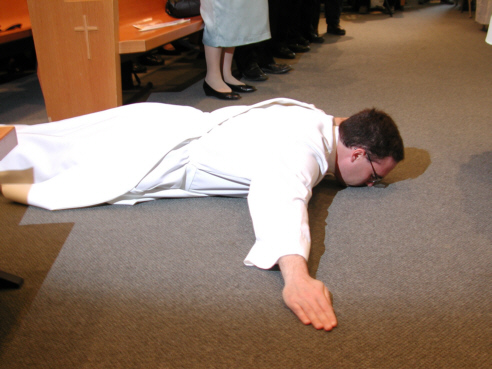
This past Sunday, in our contemporary worship service at 11:00, we had an experience that is worth sharing. Following a sermon that spoke to our need to be fully human in the face of God’s full divinity as expressed through Christ and following a powerful prayer and song that inspired us to that place of humility, one of our members, Ileana, came forward and knelt before the altar. Then she slowly lowered herself all the way to the floor and lay flat on the floor, assuming an ancient prayer position known as prostration.

Ileana and I spoke this week, and she gave me permission to reflect on this event here in this blog. As I have carried that image with me all week long, I have continued to think through the power of that moment. Prostrate prayer is lying face down (often with one’s hands at the side in the cruciform shape). It is not comfortable to the face, and it is the position of complete surrender. As a matter of fact, it is the position of surrender in battle when one completely submits to the will of another. And when that submission is made before the cross, it is complete surrender to God. It is a prayer position as old as the faith, and it is depicted here in a service of ordination out of another tradition.

Prostrate Prayer

Out of that simple act of surrender, the worshiping community was then made acutely aware of something else that was happening in the room. The Holy Spirit was moving powerfully through us as we absorbed the image of one of our own submitting entirely to God. In some sense, Ileana was our priest in that moment speaking on our behalf and surrendering us all to God. And that’s when I felt the passion … the suffering … the aching and the longing within us to have God fully at work in our lives. Many who were there felt it, as well, and our worship became passionate in the fullest sense of the word.

So as I enter this Holy Week celebrating the Passion of Jesus, my prayer is that I might experience it as a time of surrender. It is about “letting go and letting God.” It is about remembering who we are as people made of the dirt (humus to human) who breathe the breath of God within our chest. Finally, it is about facing our mortal nature … our sin and our death … and submitting ourselves wholly to the God of creation.

As you embark upon this week called holy, may you empty yourself to God and wait for the Holy Spirit to fill the emptiness with life and hope! That, my friends, is what passionate worship is all about.

Family

We often reflect upon how the holiday season is a time for family. Having just come out of a holiday season, we know how powerful family can be in our lives. No matter who they are, family members have the power to profoundly influence our lives.

And family has been defined this week for me. Because I live close to my son and his family, I get to see them on a weekly basis, but I am prone to take family for granted. This week, however, I had the opportunity to visit with my daughter and her family in Hawaii, and while I was there, I stayed at a Disney resort that uses the phrase “Welcome Home” every time you arrive in the building. I was reminded yet again of how profound family can influence our lives … how much we love and care for one another and how we seek the well-being of all in the family. I was reminded just what it meant to be welcomed home.

Family is what compels us to go the extra mile. Family is what compels us to pay for plane trips to places we might only go when we otherwise might have waited until we had enough money or the time was just right. Family is when we are willing to give up our lives to provide for their well-being … to protect them … to make sure their lives are rich and full. And the sense of home that is created by family is profound. Family is largely what defines me.

Family is the term I often use for church. I talk about our church family and the family of faith. The truth is that I have often served in churches where people did not have a sense of family. They were just fellow congregants or fellow parishioners (whatever term they chose to use), but they had little sense that they were dealing with members of their family. I found in at least one church that introducing the idea of family was transformative. The people were able to move from being a loosely associated gathering of believers to a new place where they behaved as family.

And it is a family that is never too large. Years ago, I was told of a family during the Great Depression that always left an empty place at their table for Jesus, and when a stranger was in need of food, they considered the gift of the very presence of Christ to be at their table when the seat was occupied. There is always room at our table for new members of our family, and there is always room at the table of Christ for anyone who seeks a seat.

When we celebrate the gift of Holy Communion, also known as the Lord’s Supper, I pray that we might experience the power of what it means to be a family. I have come to realize that the bible is true (and even the modern field of genetics holds this up): we are all created from common ancestors. We who share this great human race are descendants of common parents.

So I celebrate today our common ancestry. No matter who we are … no matter what we look like … not matter who we love … we are family! We are created by God to share in this family, and I look forward to the day we no longer distinguish between ourselves. I look forward to the day that we greet all of our brothers and sisters with the common greeting, “Welcome Home!”

Thank God for family … for my own family and for the great family of faith!

A Time to Reflect

The end of the year is always the time to reflect. It is a time for endings and a time to beginnings. In 2014, I became part of the “senior generation” in my family. In 2014, I experienced some health issues. In 2014, I fell (more) totally in love with my grandchildren as they grew from infancy into toddlerhood. It has been a year of sadness and joy and despair and hope. It hasn’t been all good, but it certainly hasn’t been all bad. If I learned one thing from 2014, it was that life is a mixed bag … the hand is dealt and my experience is what I make of it.

Above all, it has been a year of experiencing the depth and breadth of what it means to live in grace … trusting God to be God and allowing me to be … well, me. That’s the joy of our faith, isn’t it? It is all about experiencing the goodness of God while experiencing some of the harshest realities of life and death. It is about being real and laughing and crying and grieving and hoping for that new life that we know is always ahead of us!

So as we head into this new year, my hope is that all will experience the joy of following in the footsteps of this one who taught us so much about living only in grace. May you experience the comfort of knowing that God loved us enough to send us someone who lived our lives, shared our hunger, experienced the reality of our living and ultimately gave us a clear path to the God of our creation! May you experience the joy of Christ … born to us this season … as you take your first steps into 2015.

And as you take that step, may you experience it as a gift of …

Grace,

Jeff

Getting More

What are you expecting for Christmas?

I remember as a child asking Santa Claus for a bike … a remote control airplane … and sundry other items that, in my little mind, would bring eternal happiness! If I could have just that one thing, then I wouldn’t ask for anything else. Of course that lasted all of about a week or so after Christmas!

Then I was on to the next thing that I was sure would bring the happiness for which I could not wait. At some point, the toys began to get more expensive … the desires began to grow with age … it seemed the insatiable desire to be happy by having stuff would sometimes consume my life. I always wanted more.

Wellspring Christmas Ad

With that in mind, we set the theme for Christmas at Wellspring based upon this notion of getting “something more.” Don’t we want to find that something more? I have to admit that my life, from time to time, has been centered upon getting that more. But the “more” that I sought was never found where I thought it should be found.

The good news, however, was that it was never a far walk back to my faith. There was the story that I had been told. It was the story of a God who provides everything that we ever will need. It was a constant reminder that the happiness we seek is not found in things. Rather, the happiness we seek is found in relationship … our relationship with God and our relationships with one another. It is those relationships that today define the happiness that I seek in my life.

And that is the gift I seek. It is the gift of a full and abiding relationship with a God who has big plans for my life. It is the gift of relationship with others, as we share the journey and blessings of life together.

So what gift do you seek this Christmas? Are looking for something more? What are you expecting for Christmas?

Gratitude

Gratitude … for family … for friends … for health … for abiding presence when health fails … for steadfast love … above all, for the faithfulness of God, no matter what we face. Those are things topping my list for thanksgiving.

I’m not a person who cares that much for solitude, but I have become experienced in solitude in recent days. The pain and slowness of recovery following surgery has provided me with a good bit more solitude than I care for, and then Leah is with family today for Thanksgiving while I move very slowly in my recovery.

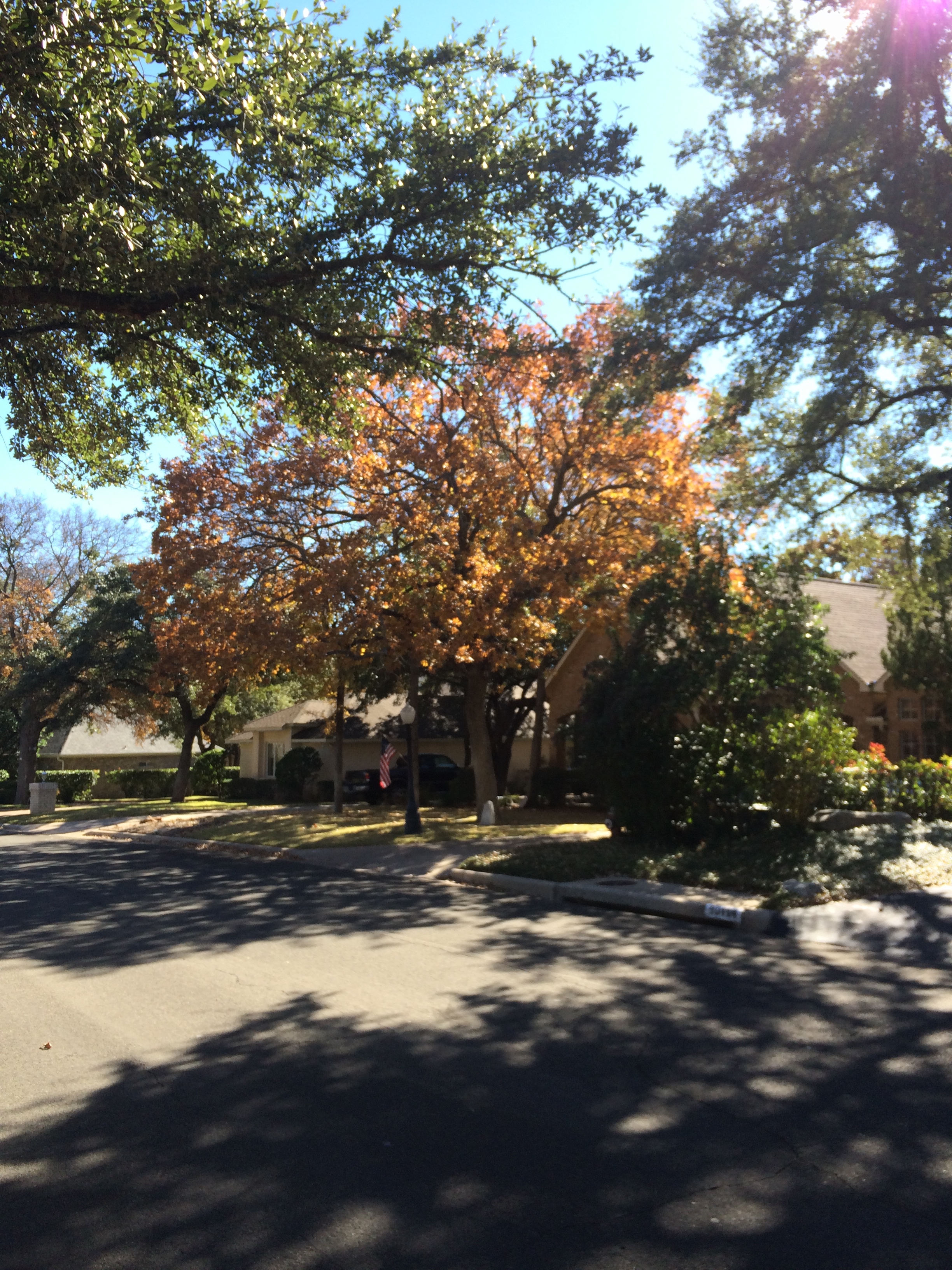
Solitude has given me time to reflect. Today, Schatzi (my pup) and I conquered a trip around the block. As I began feeling sorry for myself and feeling alone, suddenly I was struck by the beauty of my surroundings. The neighborhood is quiet … trees are in radiant beauty … and suddenly I rounded a corner where the sun and the trees engaged in a graceful dance designed to speak to my heart.

IMG_6740 IMG_6741

The quiet of the moment struck me. In the absence of sound, I heard a loud voice. The voice of a grace-filled moment: “You are never truly alone. My presence is enough. My gifts are enough.”

I felt the richness of the moment. The gift of color and light … stillness … it was impossible to mistake the message.

Gratitude … my response to such a profound message … for the blessings of eternal and abiding presence. So even without a house full of people and no table full of food, I suddenly discovered just how full my life is at this very moment in time.

Family … friends … faith … love … abiding presence. Those are the gifts of grace that fill my life, and for these things, I will be forever grateful.

May your Thanksgiving be a day of gratitude!