Journey Through Brokenness – March 15

When Covid’s Over

When visiting our daughter and her children last fall, our youngest grandson had developed a new phrase. It was comparable to phrases like: “When I grow up …” or “When I’m older …” or ” When I’m bigger …”

Our little guy was telling me all the things he was going to do “when Covid’s over.” He would say, “Pops, when Covid’s over, I’m coming to see you and Yaya in Texas.” “When Covid’s over we are all going to go to Disney World together.” “When Covid’s over …”

To be fair, my other grandchildren have used the phrase in some sense or another. He was just using it every single time he thought of something for the future. Maybe that is what is really on our mind as we think about all the things we want to do when Covid’s over.

We will return to our favorite restaurants without being afraid. We will go out with our friends …. we will sit shoulder to shoulder with strangers at sporting events … we will go to church and sing … things might seem a bit more normal when Covid’s over.

But I suspect there will be much to rebuild when Covid’ over. We have people who have politicized the virus much to the detriment of the vulnerable and the weak among us. We have lost trust with one another. We have lost our focus on community and made it more about the self … our individual liberties.

When Covid’s over the USA will likely have accounted for as many as 600,000 (maybe more) of it’s citizens who have died to the disease, and it appears it could have been far less had we viewed social distancing, mask wearing, and timely vaccinations as gifts we share with the community. When Covid’s over, we will have much work ahead of us as we seek forgiveness and reconciliation.

The march toward a more just community will only have just begun when Covid’s over. This is our time to discern that following Jesus means caring for our neighbors. It is means that we find neighbors, as Jesus did with Samaritans and Syrophoenicians and gentiles and Jews and saints and sinners.

But you see, Jesus didn’t wait for anything to be over to practice solidarity … to bring healing … to speak forgiveness … or to build community. He lived in a time of oppression. He lived in a time when Romans had ultimate authority over their land, and the people with whom Jesus ate and drank on a daily basis were people who did not enjoy Roman citizenship … they were considered as subjects (maybe even refugees) living on what was now Roman land. Their torture and executions came with little thought or consideration and certainly no loopholes that could protect them.

If Jesus had said that these things couldn’t happen until “foreign domination” or “religious corruption” was over, we might still be waiting.

Please don’t get me wrong. My thinking here isn’t to say that we go out an put ourselves or anyone else in danger as many of our fellow citizens have been carelessly ignoring the deadly virus. My thinking here is that, if we are waiting to practice grace and forgiveness … if we are waiting to build relationships and to build bridges across our expanses of estrangement … if we are waiting for the pandemic to end for us to build community in new and creative (think Covid-safe) ways … then it might never happen.

Friends, we are the body of Christ. As the body of Christ, perhaps we should lead the way in setting the example of how we can create community in ways that are safe and respectful of our most vulnerable neighbors. As the body of Christ, we can call people and visit with them on the phone. We also have many ways to video chat. For those we desperately want to see, we can practice quarantine and mask wearing and social distancing. As more and more are vaccinated, we can be the body of Christ by inviting people into safer spaces while still following CDC guidelines.

The good news is that we don’t have to wait until Covid is over before we act as the body of Christ. Jesus was creative in how he encountered people. There were times when he healed without touching, and he forgave without seeing. With a little creativity, maybe we too can be the body of Christ without having to wait any longer.

Lord, let us not wait until Covid is over to be your people. Amen.
Journey Through Brokenness – March 14

The Message of Hope

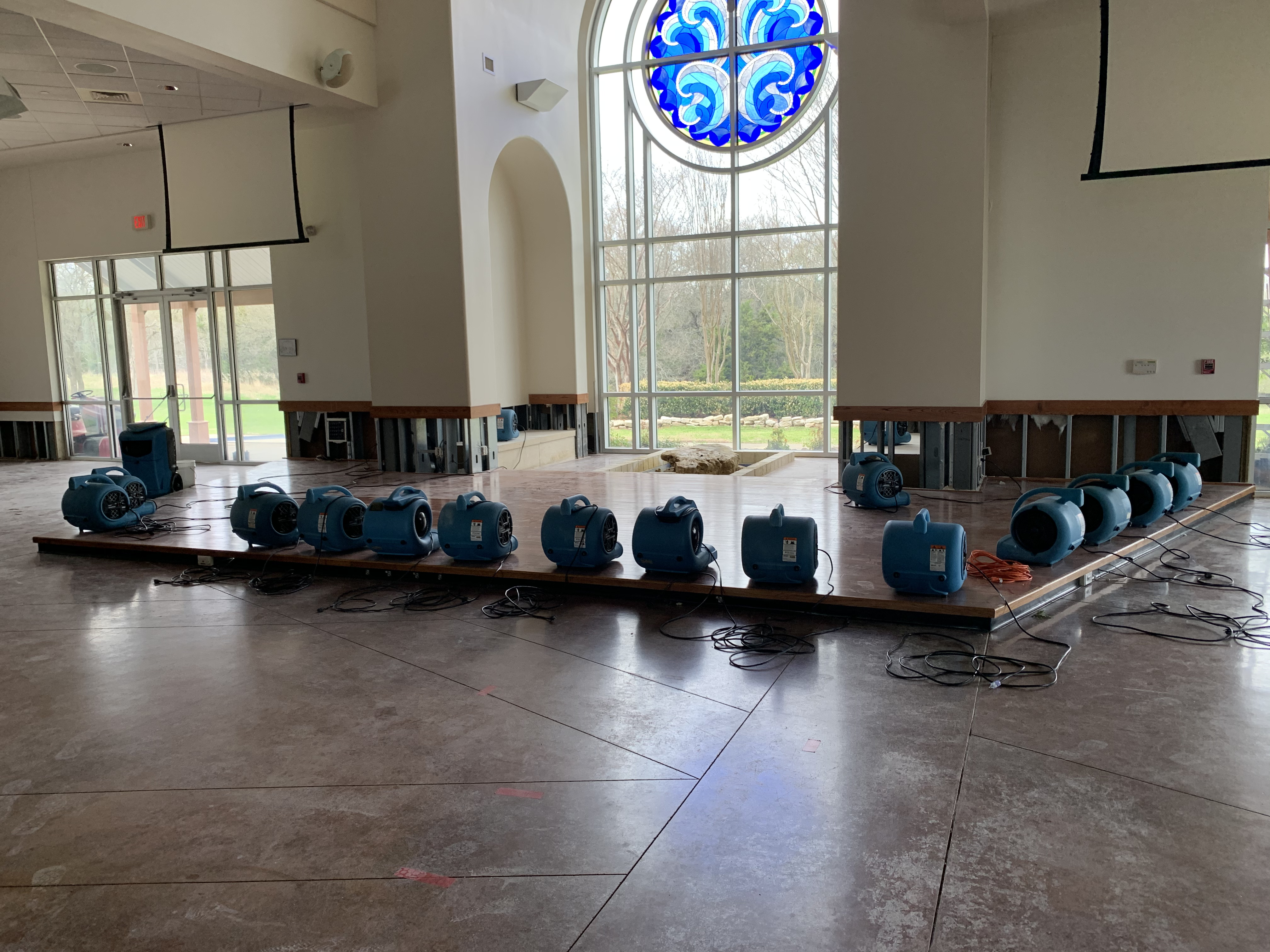
“Just when it doesn’t seem it can get any worse,” begins multiple adages I have heard through the years. We thought we had enough with the pandemic and the multiple challenges and isolation it has brought in the last year … until we experienced a winter storm like Texas has rarely known. We had adjusted to how we had to convert our sanctuary into a studio until everything flooded following that storm. Now the sanctuary is torn up, and we have been pushed out to the reception area we call the Munch and Mingle.

(Photo below is also listed on our Facebook page seeking appropriate captions)

So where is God in the midst of this when things go from bad to worse? In all my years, that has been the most common challenge from those who are somewhere between agnostic and atheist. My high-dollar theological education taught me to come up with sophisticated answers about theodicy (the theological reflection on the problem of suffering … especially among believers.

It is also tempting to just avoid the question or use trite phrases about it being a matter of faith. As if to say that those who ask the question just don’t have a deep enough faith.

But as I have aged a bit, I have come to realize that this is a legitimate question put forth by people who are using their critical thinking to evaluate what we defenders of the faith are saying. When things go from bad to worse, where do we find God?

I was told a story many years ago about a preacher who stood in front of the congregation and said, “God has richly blessed us with wealth and prosperity.” Upon hearing this, all those in the congregation who lived in poverty and who struggled to make ends meet got up and walked out.

The pastor then said, “We thank God for the blessings of marriage and happy families.” Those who had divorced and whose children had left home in anger never to return again and whose families were otherwise estranged from one another walked out of the sanctuary.

Then the pastor said, “We thank God for health and strength,” and those who were in poor health and struggled with mobility left the room.

Soon the pastor realized that no one was left in the sanctuary. He walked out to find out where everyone went. They were standing in the parking lot talking to one another. When he asked them why they had left, they told him that the message he was proclaiming had little to do with their lives.

The preacher then asked what they would wish him to say, one of the wise sages in the congregation replied, “All we need to know is that, no matter what we face, God is with us.”

The pastor then announced his new message: “No matter what we face, God is with us.” And the congregation began a journey toward becoming a more authentic people of God.

Lord God, be with us that, no matter what we face, we will know that you are wish us. Amen.

Journey Through Brokenness – March 13

Connecting Our Narratives

The first question asked by a human in the bible is asked by Cain. After he rose up against his brother, Abel, and killed him, God comes asking Cain where Abel is. Cain’s response is, “I do not know; am I my brother’s keeper?”

It is a question that is asked over and over throughout human history. Are we responsible for our siblings … our fellow humans? There are so many times when we don’t want to have to care … when we don’t care. That question is implicit in the ways we have enslaved, abused, slaughtered, and declared war on one another.

We only want to be in relationship with people who either look like us or who agree with our religious, political, or social views. We tend to find it easy to create an “us” versus “them” way of thinking and behaving.

Yet God created us for relationship, which is often the hardest thing to do.

This Sunday will mark the one year anniversary of our last worship service together. During this pandemic, the thing that stands out to me as a pastor is how much we miss being with other people. We are people who are hardwired to be in relationship, and this past twelve months has highlighted for me just how much we need each other.

As I shared in yesterday’s blog post, we have a God who comes walking alongside us … who identifies with us through our life, our suffering, and our death … yet what cannot be left out is that, because of that connection with us, we are also called to live deeply into our connections with others.

Henri Nouwen talks about this connection in much of his work, but he says it well in his book, The Living Reminder: Service and Prayer in Memory of Jesus Christ:

We have inherited a story which needs to be told in such a way that the many painful wounds about which we hear day after day can be liberated from their isolation and be revealed as part of God’s relationship with us. Healing means revealing that our human wounds are most intimately connected with the suffering of God…. By lifting our painful forgotten memories out of the egocentric, individualistic, private sphere, Jesus Christ heals our pains. He connects them with the pain of all humanity, a pain he took upon himself and transformed.

That connection with God is intimately lived out in human community. The greater pathology and the most devastating brokenness is lived out in isolation. Yet when we live deeply into how God has connected us to one another, we discover that there is healing beyond the brokenness and life beyond death.

God who connects us to one another: Remind us that we belong to one another, and remind us of the healing and hope that is born of that connection. Amen.

Journey Through Brokenness – March 12

Making the Connection

Dalya is part of a movement in Israel, known as the Women in Black … a group that protests while wearing black and holding black signs resembling hands across which are written “Stop the Occupation” in Hebrew. She is a Jewish woman opposing the Israeli occupation of the West Bank … a bold position for a woman to take.

She tells of a time when her husband had come back from war in 1967 and they made a pilgrimage to the Western Wall (what is sometimes called the Wailing Wall), and she noticed the significant changes that were happening there. She realized that people were being evicted from their homes. Arab/Muslim people being displaced by Jewish people.

Gathered there were a group of Muslim women who were praying and keeping vigil, and she found herself just standing with them … praying her prayers. When the women there asked why she, this Jewish woman, had joined them, she simply replied, “I came to stand with you.”

During this season, we focus a lot on the crucifixion, and we talk about the sacrifice of Christ. Theologically, we often think of this as what is formally known as “penal substitutionary atonement.” Jesus came to take away our sin much like the sacrificial animals that were slaughtered in temple worship. He took our punishment so we don’t have to experience it ourselves.

I think this theological position completely misses the point of incarnation … God born as us. Jesus did not come to die FOR us … Jesus came to die WITH us. God comes in Jesus as an act of solidarity, and you and I are called to carry out that work as “the body of Christ” in solidarity with others.

One of the key reasons we have so many people who have left the church is that the idea of “penal substitutionary atonement” no longer makes sense. They still experience all the suffering in their own lives and in the world. They see people die, and they know that they themselves will one day die. They understand that their actions have consequences and that the consequences of sin are rarely magically erased, and they wonder about a God who just lets all this happen and about a church that continues to defend a doctrine like this.

They have stopped waiting on a God to wave a hand and watch it all disappear. What if they are simply looking for a God who will come stand with them amidst their grief and sorrow … amidst their suffering and their dying?

A friend taught me years ago that the best way to understand atonement was to break it apart into smaller words. Jesus comes for the purpose of “at-one-ment.” Jesus reminds us that God comes to stand with us, and when we are “at one” with God, just perhaps we can face our brokenness and our suffering a different way.

God who Stands With Us: May we experience the power of “at-one-ment” with you … through Christ who stands with us. Amen.

Journey Through Brokenness – March 11

The Only Way is Through It

Part of my childhood was spent in Weatherford, Texas, and it was during those years that I think I had some of my craziest adventures. My friend, Zach, and I would walk home from school through creek beds, and we built forts in the wooded areas near our homes. There were more than a couple times that we encountered those things that would have been our parents’ worst nightmare, but somehow we always managed to live to tell about it.

That day, we were working on our fort that we were making from fallen logs, leafy twigs, and a few bricks and broken plywood that had been dumped by the road by homebuilders in our area. It was getting late, and we decided that we should head back to our homes.

As we started through the woods, Zach stopped dead in his tracks. As I looked around him, I saw what he saw. A bobcat was standing just on top of an old fallen tree, and he had spotted us. We didn’t know what to do. If we tried to run away, would it chase us? If we moved forward, would it go any better? What if we just stood still? The longer we stood there, the more I liked the idea of making a run for it.

Zach, who was caught in that world somewhere between hero and lunatic, whispered to me, “The only thing we can do is walk toward it?”

What?!? Nothing in my mind said to walk toward the animal. Zach reiterated it: “The only way is through it.” He whispered that he knew about them. We were big enough that it didn’t think we would be prey. If it had rabies, it would have already come at us. If we ran from it, it would trigger a predator response. Standing still wouldn’t likely go very well, either. The only thing we could do, according to my brave, knowledgable friend, was stay on our path and let it know that we weren’t going to be deterred. We were slowly walking through the danger zone!

In hindsight, I’m not sure I should have trusted the knowledge of another 5th grader, but I wasn’t sure that I really had a choice. So we stayed on the path that led closer and closer to the bobcat. Amazingly, the bobcat turned and scampered away from us into the woods.

The only way is through it.

In Numbers 21:4-9, we find an interesting story of the children of Israel who are journeying in the wilderness, and they began to complain. The journey was hard. Why had God brought them out of Egypt if their only fate was to die.

As they continue to complain, we are told that God sent serpents among them, and the serpents bit them and several of them died. Then the people began to realize their sin … they repented of their sin against God and Moses. God then told Moses to put a serpent at the end of a pole and lift it up in front of the people that they might live.

The complaint here is interesting. They ask Moses, “Why have you brought us out of the land of Egypt to die in the wilderness? For there is no food and no water, and we detest this miserable food.”

Is it just me, or is the last line funny? That last line I find humorous: “We have absolutely nothing to eat AND we hate what we are eating.” I’m pretty sure I said the same things to my parents when I was a kid.

Moses then fashioned a serpent out of bronze and put it on a pole. He then held it up in front of the people. They looked at it and lived.

Let me initially state that I do not believe, in any way, that the God we worship would send snakes among the people. Jesus asks of us, with our propensity toward evil, if would not know better than to give the child who asks for fish a snake instead? God certainly would not do such a thing.

What I do believe is this: when we focus on the darkness, it is really hard to see the light. I was pretty sure that 2020 was the worst possible thing that could happen to us. It was a year of pandemic … with disease, death, and the fear of the unknown. It is true that we suffered through a challenging year; there is no disputing that reality. Coming into 2021, I was busy looking back at how much had been taken from us. The routines … the people who have moved in this time … the deaths.

But just when we thought it couldn’t get worse, the opening act for 2021 was a winter storm unlike many of us have ever known. And while there is good news in our fight against Covid, the variant strains of the coronavirus are out forging their own paths of destruction. It feels like the snakes have arrived.

I have discovered that same truth in my life. When I am pretty sure that there is nothing worse that can happen to me, pretty soon I am standing amidst a sea of snakes.

And who of us has not wished we could just go back the way we came? We want to go back to our pre-pandemic routines. We have promised that we will never again take granted things like seeing our families, eating out, worshiping with our friends, strolling through our favorite stores and shopping centers and generally just being in the outside world.

We repent of our inability to see or appreciate those good things. Now can we just go back? Not sure about you, but I am hearing a resounding, “NO!” The way is not backwards … it is forwards. The only way out is to go through it.

Moses then holds up a symbol, but it is not a symbol of something warm and fuzzy that we imagine from our pre-pandemic days. It is the snake itself. We are told that the only way to get over our snakebites is to behold … embrace … the snake itself.

Maybe that is why Jesus tells Nicodemus, as we will share this week in worship, that he will be lifted up like that snake. Not that Jesus is the snake, but the symbol referred to here is the cross.

The only hope for brokenness … suffering … death is through it. By gazing on it … by embracing it … by owning it, we discover victory! Ultimately, the way to abundant life takes us through the valley of death.

Lord, you come to us in the most unusual and remarkable ways. May we see you even as we face the darkness and brokenness that surrounds us. Amen.

Journey Through Brokenness – March 10

Living in the Dash

A friend of mine, Ann Joyner, is the author of Not Worth Saving: How a Severely Handicapped Boy Transformed Lives. I was privileged to read an early transcript and write an endorsement that was included in its publication. Ann and Jerry had two sons, Drew and Matthew. Matthew, their youngest, was born with severe mental and physical disabilities … he would never communicate verbally or learn to read or write … but he would profoundly touch lives.

Matthew died when he was 21 years old. Her book was about his life.

I had been given the opportunity to serve as one of their pastors at the First United Methodist Church in Arlington, and during my time there, Ann had served as a part-time staff member. Just after I began my doctoral degree at St. Paul School of Theology in Kansas City, MO, they moved their family to Overland Park, Kansas, just outside of Kansas City, so I was privileged to stay with them when I would go up for my residential requirements.

During that time, they became part of the United Methodist Church of Resurrection, before the church had bought land and begun journeying toward becoming the largest church in the entire denomination. I had worshiped with them when they met in a school, and I had worshiped with them in two of their sanctuaries as their church began to expand and grow.

At some point after I had graduated, I remember Ann telling me that the church was opening a new columbarium (a final resting place for cremated ashes) on the campus and that they had paid for niches for her, Jerry, and Matthew. And she told me, “We are now living in the dash.”

When I inquired further, she sent me a poem she had read (which is now very widespread) about how tombstones and monuments will have a person’s date of birth and their date of death separated by a simple dash. But those two momentary events frame a lifetime of living. In that dash are all our dreams and our hopes … our losses and our failures … our living and our loving. And it is all wrapped up in that dash.

In her book, as she told the story of Matthew’s life … his dash … I remembered the times I had been with him, and the ways he would coo and make an effort to communicate. There was one visit, where I had a lot of writing to do, and I had agreed to watch Matthew while Ann and Jerry went out for the evening.

I was stressing over the work I had to do, but I also was worried about a matter I had deal with back at the church in Texas. Mattie had been glued to the television, but he crawled up next to me on the couch as I sat there with my book in my lap. It was like he could sense my stress. He curled up under my arm and just stared into my eyes. In those days, I had grown a full beard, and as I looked at him and talked to him, he put his hand up and just started stroking my beard.

He was at once curious about the tactile sensation of a hairy face and how he might offer his own sign of comfort in that moment.

In his own way, he was living in the dash … making the most of life as he saw it … and he was inviting me to see the world the way he saw the world. It was an invitation to simplicity. It was an invitation to grace. I didn’t need words or complex reasoning.

I just needed to be reminded of the primacy of love. Life was complete in that moment.

After Matthew’s death, the church commissioned a huge stained glass window across the front of their new sanctuary, and it stretches from wall to wall. The glass is 100 feet across and 40 feet tall.

You can find more information on the stained glass window at Church of Resurrection by clicking HERE

Section of the Resurrection Window in the sanctuary at Church of the Resurrection. Matthew Joyner (here enlarged and highlighted) is beneath the horse of John Wesley.

Matthew is featured on the far right side of that window (which more broadly features the three gardens of the biblical witness), and he is in the garden of promise. The image of him and the little girl is enlarged here, but he sits at the feet of John Wesley’s horse. He is reading a book and talking to a little girl of Native American descent. Reading and talking were two things he never did in this life.

He is in the flow of the great witness of the church … of all the saints who have sought to live out the message of hope that is greater than our despair and the wholeness that is greater than our brokenness.

So as I have encountered suffering and brokenness at various times in my life, I remember Mattie and his warm, gentle reminder of hope, trust, and love. While living in the dash, may we be living reminders for people that God’s grace will always be more than sufficient for any brokenness or even death we may experience.

God of gentle, reviving grace: Thank you for the messengers you send into our lives to remind us of a living hope that is greater than anything we have ever known. Amen.

Journey Through Brokenness – March 9

Love is in the Air

The two times I have eaten out during the pandemic, it was outdoors on a patio of one of Georgetown’s fine restaurants. They had taken all of the precautions. Patrons wore their masks until they were at the table. They were then encouraged to wear their masks when they were not eating or drinking. They had fans that moved the air. The first time I ate there, the fans were spraying a light mist. The second time I ate there, it was too cool for the mist, but the fans continued to slowly move the air.

Each time I ate there, I worried about what was in the air. This pandemic has taught us to think about the air … not good thoughts … but thoughts nonetheless. Who in our space might be infected with COVID-19? Who is out despite feeling a bit sick? Who is asymptomatic and has no clue they are spreading the virus? Is the moving air enough to keep others safe?

It is all about what is in the air!

Paul, the biblical author of numerous letters who refers to himself as an apostle by faith, shares about what is in the air. In his letter to the Ephesians, he talks about the sin and brokenness in which we find ourselves. In the second chapter of that great work, he talks about sin so contagious that it is in the air we breathe. I think it makes most sense to turn to a modern paraphrase that comes from the late Dr. Eugene Peterson:

It wasn’t so long ago that you were mired in that old stagnant life of sin. You let the world, which doesn’t know the first thing about living, tell you how to live. You filled your lungs with polluted unbelief, and then exhaled disobedience. We all did it, all of us doing what we felt like doing, when we felt like doing it, all of us in the same boat. It’s a wonder God didn’t lose his temper and do away with the whole lot of us. Instead, immense in mercy and with an incredible love, he embraced us. He took our sin-dead lives and made us alive in Christ. He did all this on his own, with no help from us! Then he picked us up and set us down in highest heaven in company with Jesus, our Messiah. (Ephesians 2:1-6, The Message)

You filled your lungs with polluted unbelief, and then exhaled disobedience.

Yet in the midst of this brokenness … disobedience and sin … God, who is full of this indescribable love, embraced us, and made us alive in Christ. When our lungs were filled with stagnation, yet the powerful love of God was also in the air … clearing away the pollutants of sin … and breathing new life into us.

It is this God who picks us up from our brokenness and “sets us down in the highest heaven in company with Jesus, our Messiah.” These images are like a breath of fresh air.

So as we continue to think about what is in the air … as we practice love by wearing our masks and protecting our neighbors … as we refrain from hugging as the best way to wrap our friends in the arms of loving care … maybe we can see that the air is really filled with love, after all.

So breathe deeply and welcome this God-breathed gift of healing and wholeness into our lungs. Love is, in fact, in the air.

God, your love is amazing! May we be those who breath in your incredible grace and breathe out divine love into the world around us. Amen.

Journey Through Brokenness – March 8

The Significance of 3:17

I had a member of my staff many years ago that used 3:17 for virtually everything. He had it on his wall … a tee shirt … a coffee cup. After he had been with me for a brief period of time, I finally asked the obvious: “What is 3:17 about?” And he had the most amazing response.

He said, “Everywhere you go, you always see ‘John 3:16.’ It’s on bumper stickers and artwork and tee shirts. People even hold it on signs in end zones at football games. People often use that passage to draw lines between people who believe and don’t believe and use it to pronounce those who get God’s love and those who don’t get God’s love. I’m pretty sure people wouldn’t be that way if they paid attention to John 3:17. ‘God did NOT send the Son into the world to condemn the world, but in order that the world might be saved through him.’”

We are people who live according to some very dualistic principles without even knowing it. Even in computing, we are caught up in binary code … everything is understood according to 1’s and 0’s. Our entire computer systems fall apart if we introduce a 2 or a 7 into the code. It just doesn’t work.

In the same way, we are constantly dividing the world according to notions of black and white … who is in and who is out … who is right and who is wrong … who is saved and who is damned. And it is easy to use that first favorite verse that way: “For God so loved the world that he gave his only Son, so that everyone who believes in him may not perish but may have eternal life.” We take something intended to be the “Good News” and weaponize it to further divide the world.

John 3:17 is intended to give it balance. It is intended to remind us that Jesus does not live according to dualistic principles or binary code. Jesus introduces in this very important sentence the possibility of a third way of being. This isn’t just about those who believe and those who don’t believe; it is about the radical love of God that respects none of our boxes or boundaries. It is about a radical grace that is greater than any possible conception of judgment. It is about a reconciliation that is beyond our divisiveness.

Ultimately, it is about an abundant, abiding wholeness that is beyond the worst brokenness we have experienced … it is about life that is beyond our darkest fear of death.

So when you see or hear John 3:16 written or spoken, I invite you to join me in refusing to stop there. Like my former colleague, make John 3:17 be your new favorite: “God did not send the Son into the world to condemn the world, but in order that the world might be saved through him.”

Lord God, you come to us as the God of wholeness and life amidst our world of brokenness and death. Remind us of your reconciling, radical third way of speaking into our divisive world your ways of grace! Amen.

Journey Through Brokenness – March 7

The State of Unknowing

A few years ago, I had to return something to a big box store right after Christmas. I had finally made it to the head of one line, and there was a lady next to me who had made her way to the head of another line. The young man who was trying to help her was very new to the job and had been thrown in the deep end of the pool. Not only did he have to deal with customers who were sometimes very frustrated over the wait, but he also was charged with answering the main phone.

As we stood there, the woman could tell he was lost. As she was just getting him to help her with her return, the phone began to ring. He froze in the moment … completely overwhelmed. Fortunately for the young man, the woman happened to be an HR executive. She took charge as he looked at her and then the phone, clearly not knowing what to do next.

She looked him square in the eye and said, “Pick up the phone.” He picked it up, still frozen in the moment. She glanced at his name tag and scripted him: “Thank you for calling Hypermart, my name is Matt, how may I help you.” He repeated her word for word. As the person on the other end of the line spoke, he suddenly regained his composure, transferred the caller to the right place, and looked back at the woman and said, “I am so sorry. I just suddenly didn’t know anything. Thank you for helping me not get fired.”

It was a humorous yet enlightening moment. While it highlighted the sometimes overwhelming world we have created for ourselves in a capitalist economy, it also reinforced for me the value of “knowing” as opposed to “not knowing” in our culture.

As I have now embarked on my 6th decade in this world, I have begun to learn the value of not knowing.

In my training as a certified coach, I was taught that coaching is different from consulting. The consultant is the expert we bring in to tell us how to do our jobs or live our lives better than before. They are people who operate out of a place of knowing.

Coaches, on the other hand, specialize in not knowing. This comes as a challenge for me, especially in my role as a pastor because of my training in all things church and religion. I am supposed to be the one who knows, and it seems counterintuitive to move to the place of unknowing.

The interesting thing here is that unknowing here is more intentional than ignorance. It is the capacity to glimpse the reality that is greater than what my eyes can see or my mind can grasp. It is then a curious and intentional way of saying “I don’t know” that invites the mysterious sacred unto the moment.

This is the place of wisdom. Faith … pure faith … is that leap into the darkness and mystery of God without knowing where it leads. It is facing the moment of death without knowing what awaits us on the other side. In our lives, we each face small deaths without knowing. We lose a job and don’t know what is next. We face an addiction not knowing what life will be like without the object of our addiction. We face the loss of someone we love dearly without knowing what life will be like on the other side of that loss. We then face our own physical death without knowing what awaits us beyond the darkest of darknesses.

As we talk about the brokenness of the church and other institutions that have held our allegiance, we ultimately don’t know what is on the other side. As we face the brokenness of United Methodism … which feels a lot more like my typical typo, “Untied” Methodism … there is a certain anxiety in admitting that I don’t know what awaits us on the other side.

As a pastor, I think my people expect me to know, and the answer, “I don’t know,” doesn’t always come off as comforting to them. But if we are to grow as a church, I am inviting us to the place of unknowing.

In the place of unknowing, we might be able to see one another and listen to one another. In the place of unknowing, the story of others … many who live in the margins … can take center stage. In the place of unknowing, we can let go of privilege and power and the need to be right.

The place of unknowing is exactly where God meets us. So perhaps the brokenness we experience in life, both individually and corporately, can be a springboard from which we can take our first steps into a new community. I think Jesus’s vision of the Kingdom of God and Dr. King’s vision of the Beloved Community define that new community.

So join me in the place of unknowing. In this space, God who knows every fiber of your being and every particle in the universe offers us a wisdom that comes, not from knowing or understanding, but from unknowing. That is the definition of faith.

In the silent place of unknowing, may we practice a moment of stillness and fold ourselves into the mystery of God.

Journey Through Brokenness – March 6

From The Way to Christianity to Christendom to Reformation to Whatever Is Next

I follow a podcast known as The Liturgists, led by a group of millennials who represent a large segment of the population. These are people who have been hurt by the institutional church. They are people who have pushed the institutional church to listen to their cries for justice and equality and hope for a better future. These are people who have angrily given up on the institutional church. Finally, they are people who have walked away either in complete silence or, at best, with their hands in the air with a silent vow never to return.

This season of their podcast began with two episodes that intrigued me. The first was titled Is Christianity Worth Saving? (which certainly got my attention since it is kind of a big part of my life), and the second one is titled Reformation (which is about the ways we can seek transformation beyond the brokenness).

One of the things that is highlighted is something that we have come to understand about church history. An analysis of church history reveals that every 500 years, the church experiences the movement from order to disorder to reorder. In seminary, I learned it as the flow from construction to deconstruction to reconstruction It is nothing new really. What we are finally talking about is the flow about which Jesus taught. We ultimately go from life to death to resurrection.

The earliest followers of Jesus called themselves the people of The Way. They were a movement and not an established religion, as such. They were practicing Jews along with others outside of the faith who were beginning to explore this Hebrew-informed expression of faith introduced into their lives.

By the time the letters of Paul and the gospels were being written, the earliest followers were being called Christian. This group was a little more defined, yet it was still a movement. In 314 CE, the Emperor Constantine made Christianity the official state religion of the Roman Empire, and thus launched what historically is known as Christendom. Then by 500 CE, the Church was firmly established across the Roman Empire.

By 1,000 CE, the Church is more than the church. It is the Holy Roman Empire and is considered the only legitimate successor of the Roman Empire. This is where some of the greatest abuses of the Church are perpetrated.

Then we come to the 16th century and the Protestant Reformation.

In 2017, I had the chance to join my son (who is the Director of Music at First Presbyterian Church in Georgetown) and his choir in the production of a CD that was centered on a Dan Forrest arrangement of A Mighty Fortress Is Our God (featuring our family anvil that alluded to the nailing of the Luther’s 95 Theses to the door of the church at Wittenberg), thus launching the Protestant Reformation in 1517. So the piece commemorated the 500th anniversary of this historic moment in time.

According to history, it is time for some other great shift in the global Church.

As we experience what I have been calling the brokenness of the institutional church, I think the question we might ask is, “What is next?” As we own up to the ever-growing irrelevance of the Church with each new generation, what is the reformation that is needed now?

As I have settled more deeply into many of the teachings of the mystics and contemplatives who have become active at various times in the life of the church, I have come to believe something that I have felt deeply from the beginning of my ministry.

It is the call of Christ to shed the trappings and return to the center.

The center for me is how we see ourselves as part of a larger creation. It is what undergirds my theme of “letting go and letting God.” It is about how we care for the environment, and it is about how we care deeply for the “all” to whom we refer in our motto: “ALL are welcome, ALL are accepted!” And the tagline we almost never leave off these days: ALL MEANS ALL!

The center is Christ as lived out in the Body of Christ … the movement of those who follow Jesus, this most radical Christ of ours.

So as we find ourselves deeply in the second Lenten season of a global pandemic, we are feeling deeply the disorder … the deconstruction … the death that confronts us. Maybe this is the time for us to act up and act out in transformative ways. Maybe this is the time to embrace the brokenness … the death … that we might look together toward a life to which God is calling!

What is next for us? Come and see!

Lord God, who has walked with your people and the Church through seasons of life and death and resurrection: Walk with us now that we might walk through the brokenness to the place of hope and life deeply lived in you. Amen.